Traumatic brain injuries can be debilitating and sometimes culminate in permanent disability. While many people who experience a TBI are simply the victims of an unlucky accident, certain careers carry an outsize risk for brain injuries.
Many of these risky jobs are in the military, and that’s why the United States Department of Defense has invested millions of dollars into university-based research aimed at preventing, detecting and treating TBIs. Much of that work is performed by an interdisciplinary group of engineers and scientists involved in PANTHER. The multi-institution collaboration led out of the University of Wisconsin–Madison College of Engineering is developing better methods for diagnosing TBIs, as well as advanced materials that promise to make military helmets better at preventing injury. These advanced materials are also improving helmets used by others, from law enforcement to athletes.
It’s this kind of “dual-use” research, meaning research that benefits both the Department of Defense and civilians, that UW–Madison leaders are hoping to attract more of in the coming years. The push is part of a broader strategic effort led by the Office of the Vice Chancellor for Research to increase DoD research funding and expand the university’s national security-oriented research and education opportunities.
“This is about research portfolio diversification and making sure that UW–Madison is not overly reliant on one or two primary funding streams when there are many national security priorities that fit with the research we excel at,” says Vice Chancellor for Research Dorota Brzezińska.
The defense department’s research interests are broad — from cybersecurity and quantum computing to food security and disease detection and treatment. Brzezińska is confident that UW’s similarly broad research portfolio is well positioned to attract new investment from the agency, even in areas where a connection to military applications may not be obvious.
“Many people don’t realize that DoD research is not about developing weapons only,” says Brzezińska. “There are many things that we take for granted that actually came out of dual-use research sponsored by DoD.”
Brzezińska would know. Her own research career has focused in large part on enabling and developing scientific and civilian applications of GPS, a technology that has fundamentally changed civilians’ relationship with navigation and originated in DoD-sponsored research.
“I think many UW–Madison researchers are interested in contributing their ideas to addressing national security challenges that would also result in advancing civilian technologies and generating economic benefit for the state and the nation,” says Brzezińska.
A strategic pivot to building better relationships
Defense-oriented research has long been an important source of federal funding at UW, even while other agencies like the National Institutes of Health have traditionally sponsored more campus research projects.
What’s new is a nascent campuswide effort to build on existing relationships and develop closer ties between UW researchers and decisionmakers at DoD, defense-related industries, and other government partners focused on national security, like Sandia National Laboratories.
The strategic pivot is coordinated by the Office of the Vice Chancellor for Research and the Office of University Relations, which includes the university’s federal relations and business engagement arms. While Brzezińska has her own decades-long relationships with DoD, the two offices recently hired Dave Schroeder to be the university’s inaugural Director of National Security Initiatives, tasked with identifying national security research opportunities and building strategic defense-oriented partnerships.
“Development of UW–Madison’s relationship with the Department of Defense will provide additional research opportunities to examine real-world issues, in addition to leveraging the industry strengths and workforce opportunities within the state of Wisconsin,” says Vice Chancellor for University Relations Craig Thompson. “The strategic growth of UW–Madison’s DoD portfolio will strengthen our standing as a world-class university that trains tomorrow’s leaders and solves today’s problems.”
Schroeder’s role is in some ways an expansion of a position he previously held in the College of Letters & Science, where he was charged with creating opportunities for UW–Madison faculty, staff and students in L&S and beyond with defense and intelligence agencies. This included identifying research funding opportunities but also focused on building the types of relationships with government and industry officials that could eventually result in new partnerships that benefit faculty and students.
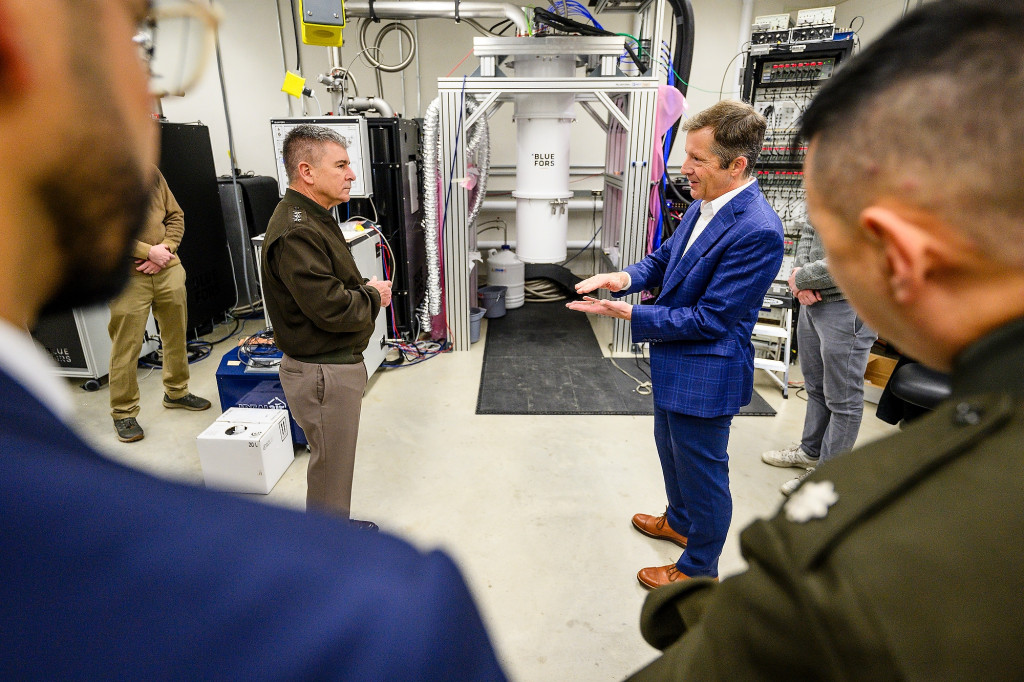
A recent example of this work was the November 2024 visit by a delegation from U.S. Cyber Command that included Lt. Gen. William “Joe” Hartman, now the acting head of both U.S. Cyber Command and the National Security Agency. The delegation toured labs and met with researchers in the Department of Physics, College of Engineering and School of Computer Data and Information Sciences. The visit provided a platform for agency officials to hear directly from faculty and students about their work in important cybersecurity areas like quantum computing and cryptography, and resulted in an expansion of university partnerships on cybersecurity that’s providing new opportunities for researchers and students.
“DoD and other national security agencies are very relationship-based, but once built, those relationships are long-lasting,” says Schroeder. “UW–Madison has a lot to contribute to the emerging challenges across the national security landscape, from cyber to advanced materials to agriculture, and of course the impact of AI across all of these domains. When you discover innovative solutions to these mission-focused problems, those agencies want to sustain the partnership with you, and everyone benefits.”
Broad campus support
Campus leaders at the school and college level are enthusiastic about expanding defense-related research programs.
College of Engineering Dean Devesh Ranjan touted the college’s long history of partnering with the DoD on research “that safeguards our nation while advancing technologies that benefit society far beyond the defense sector.”
He pointed to the college’s close collaboration with the Air Force Research Laboratory through initiatives like the University Center of Excellence on Efficient and Robust Machine Learning and joint work on quantum science.
“We see tremendous opportunity to expand these partnerships and to lead in shaping technologies critical to our country’s security and prosperity,” Ranjan says.
Meanwhile, the UW School of Medicine and Public Health (SMPH) is eyeing new opportunities to collaborate with the defense and veterans affairs departments. The school already has several large DoD-funded projects that could result in improved outcomes for prostate cancer patients and people with idiopathic pulmonary fibrosis, lupus and severe limb injuries.
“All the conditions needed for success with DoD funding opportunities are present at our school,” says Nita Ahuja, Dean of UWSMPH. “We have research teams with deep expertise in areas prioritized by the DoD, a track record of successfully funded projects and proven ability to collaborate across disciplines and deliver results.”
The College of Letters & Science has been strengthening its relationship with the department for years, according to Dean Eric M. Wilcots, noting that it operates differently than other funding agencies like the National Institutes of Health or the National Science Foundation.
“You need time to establish a relationship, but once they trust you, you are in for the long run,” Wilcots says, pointing to multiple large awards received by L&S faculty in recent years, including for quantum work, creating mental health programs for troops and various cybersecurity plans.
Now is precisely the right time to capitalize on these existing programs and relationships, says Brzezińska, especially as other universities move to expand their own defense-oriented programs.
“If we’re not intentional and strategic, we could miss the bus,” she says.
While securing more research funding is an initial goal, there are other downstream benefits for students, DoD and industry, Brzezińska says, beginning with workforce preparation.
“UW–Madison could be in a unique position to provide workforce to DoD. If we could bring more research here and engage with the DoD research done by graduate and undergraduate students, we could become one of the national hubs for workforce development in STEM domains.”
Written by Will Cushman
Link to original story: https://news.wisc.edu/uw-fostering-closer-research-ties-with-federal-defense-cybersecurity-agencies/